Branding
E-commerce Packaging Design for Food and Drink Brands
Updated

A jar arrives intact, but the lid is oily, the label has rubbed against the insert, and the customer has to pull the box apart to get it out. Each issue changes how the product feels before anyone tastes it. If you’re hiring a branding studio for a food or drink business that ships direct to customers, give the delivery experience its own brief.
Good e-commerce packaging has three jobs: protect the order, help the warehouse pack it consistently, and make the product feel like the one the customer chose online. Those jobs are easier to reconcile when you develop the structure and the artwork around the same real orders.
Cover photo by Egor Komarov on Unsplash.
Start with three orders you expect to ship
Pick a typical first order, a larger repeat or gift order, and the awkward order your fulfilment team worries about. For a sauce brand, those might be one jar, a three-jar bundle and a mixed order with two jar sizes. Record each product’s weight, dimensions and closure. Note where items can strike each other, what happens if one leaks, and how a customer gets the first item out. If you already ship, pull a handful of support photos and ask warehouse staff which combinations take longest to pack.
Use those scenarios to decide how many shipping formats to prototype. A single mailer can simplify purchasing and storage, but it may leave a small order rattling around or make a mixed bundle awkward. A second format earns its place if it solves a recurring packing problem or cuts enough material, time or shipping cost to justify carrying another box. Ask your fulfilment partner to pack the same orders in both options and compare the finished parcels.
Decide where the brand should show up
A shipping label, tape and handling marks already compete for space on the outside. Before approving a printed design, place an actual carrier label on a sample and see what it covers. If the box needs to stay discreet or your carrier label dominates the lid, an interior panel, a product sleeve or a simple insert can make the first clear brand impression. Use the same product name and familiar cues the customer saw at checkout so the connection is immediate.
Give every printed surface a job. The outside could help a gift recipient recognise the sender. The inside could explain which product to open first or how to store it. Leave a way to reach customer support if something arrived damaged. An insert can make sense when it solves a recurring customer question or needs to change more frequently than the box. Price recurring print and assembly before committing to it across every order.
Three food and drink packaging examples from Undoubt Studio
EM’s Cookies gives the box a job after opening. The cream-and-blue checkered gable box uses one face for brand recognition and another for illustrated storage and serving instructions. Think about what the person opening the order needs to know next. If they received it as a gift, those instructions may matter even more because they never saw the product page.
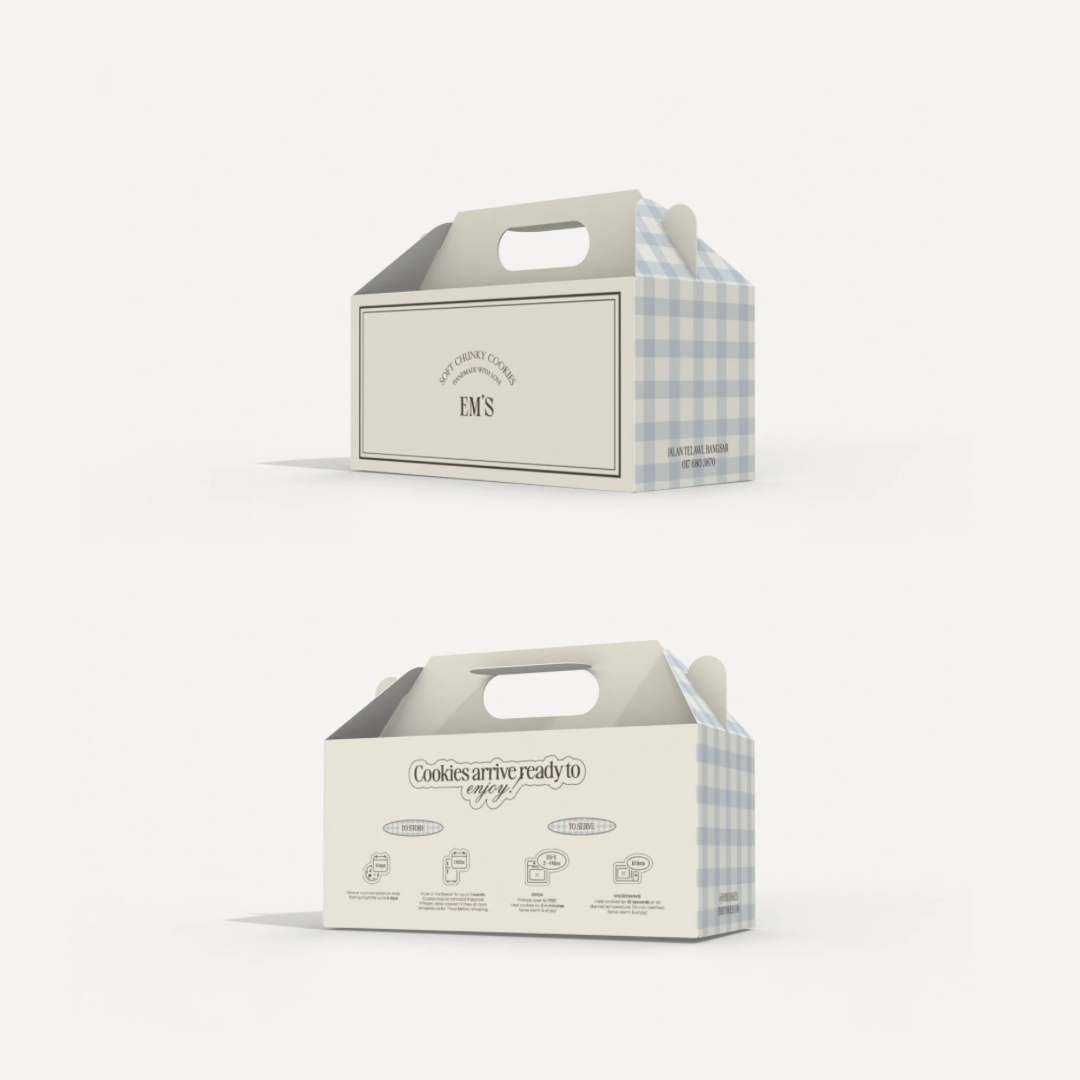
EM’s Cookies packaging design by Undoubt Studio.
Mama Chow’s carries the identity from the box to the jar. The bold red packaging and recurring typography connect the outer presentation with the chilli oil range, where red and orange labels help distinguish variants. For a mixed bundle, bring the box, jars and product-page thumbnails together at review. Check that customers can match each jar to the variety they ordered.
REVIVO makes flavours easier to tell apart. The drinks share a consistent typographic system, with distinct colours giving each flavour its own identity. For an online variety pack, use that same principle when you brief the bundle page and any printed contents guide. Keep the flavour names legible so customers can identify each can even when the colours are hard to distinguish.
If your product also needs to sell through stores, our first retail shelf packaging guide covers the decisions to test in that setting.
Test the shipped order, including the difficult one

Photo by Claudio Schwarz on Unsplash.
Make early samples with the actual products, the insert or padding you expect to use, and the intended closure. Ask someone on the packing team to assemble and label a few while you observe. Have someone who has never seen the prototype open it and photograph what they see at each step. Check whether they reach for scissors, whether products shift as they open the lid, and whether the labels are still readable when the items come out.
Use those observations to revise the design before formal transit testing. Work with your packaging supplier or a test lab to select a protocol suited to the product, parcel dimensions and distribution route. The International Safe Transit Association’s testing guidance maps procedures to different distribution environments. If your products need a controlled temperature, scope that separately with a qualified packaging specialist and confirm who owns the cold-chain requirements.
Compare the cost of a packed order
Ask for a quote based on a finished parcel. Include the box, inserts, tape, storage, packing labour and shipping charges. Price the typical and awkward orders separately so an average doesn’t hide the expensive cases. If a fitted insert adds material cost but saves assembly time, compare both numbers using prototype measurements. Use that same exercise to decide where better print or a finish is worth paying for.
Put responsibilities in the studio brief
Share product drawings, sample orders, carrier and fulfilment requirements, and early costs. Agree who owns structural design, dielines, print artwork, supplier approvals and transit testing. Before signing off, ask for the final files against the approved structure and a packing reference for each format, including the label position and where the product sits.
If you’re planning a direct-to-consumer launch or replacing a mailer your team has outgrown, explore Undoubt Studio’s branding packages. Bring a photo of your current parcel or a list of the orders you expect to ship. Either gives us a better starting point for deciding which packaging applications your identity needs.
Source notes
- ISTA’s testing guidance supports the distinction between distribution environments and test selection. The sauce orders above are hypothetical.
- The linked studio case studies document the visual identities and packaging designs discussed above. The EM’s Cookies image shows the front and back of the gable box.
- Both stock photographs are free under the Unsplash License.
Found this useful?
Views —KEEP EXPLORING


